
Your Business Website in 2027
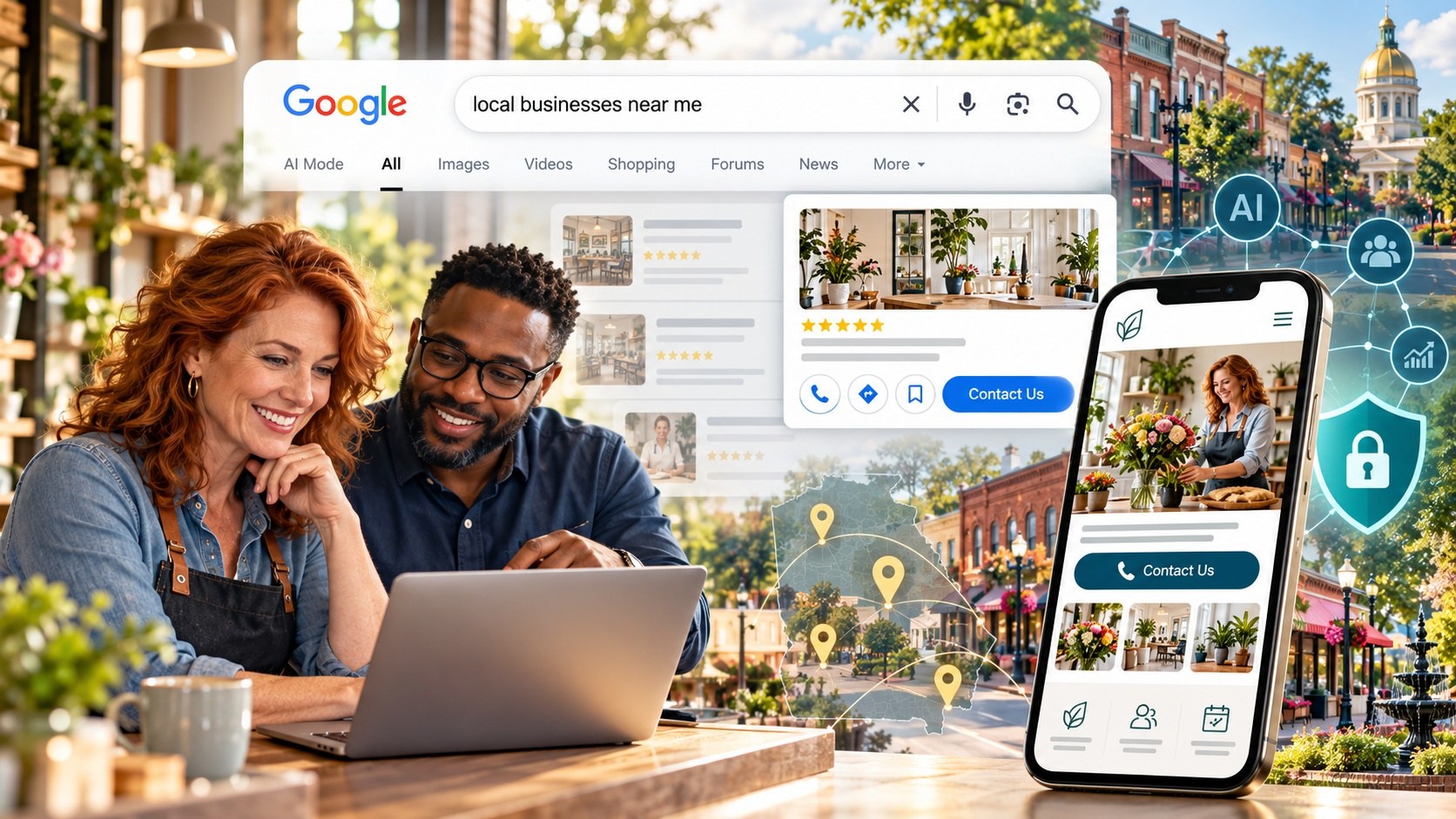
Help Customers Find You Choose You and Buy From You
Your next customer may search for a business like yours without ever reaching your homepage. They might compare companies in Google Maps, read an AI-generated answer, browse a directory, or ask a follow-up question in Chrome.
For a small business in Georgia, that creates a practical challenge: help customers discover your business, understand why you fit their needs, and contact you without unnecessary effort.
As we approach 2027, your website needs to support each of those steps. An attractive design matters. Clear information, local relevance, mobile usability, and security give that design a business purpose.
What Mattered in 2024 Still Matters Today
Our original 2024 article emphasized mobile design, loading speed, easy navigation, and conversational searches. Those priorities addressed common obstacles between a customer and a purchase.
A customer could struggle to find your business when your website lacked useful service information or clear location details. After arriving, they could leave because the page loaded slowly, the text looked tiny, or the contact form demanded too much effort.
Mobile access remains especially important. Google uses the mobile version of a website’s content for indexing and ranking. Your phone experience should provide the same essential information customers can find on a desktop. [1]
One recommendation needs correcting. Our earlier article encouraged Accelerated Mobile Pages, or AMP. AMP is not a requirement for Google visibility, and Google says AMP itself is not a ranking factor. Focus on a fast, usable website rather than a particular technology label. [2]
Late 2026 Search Gives Customers More Ways to Compare You
The Google search interface offers choices: AI Mode, All, Images, Videos, Shopping, Forums, and News. Customers can move among these options according to what they need.
Someone researching a contractor might want project photos. Another person might look for reviews or compare services through an AI answer. A shopper might search for a product before searching for the store that sells it.
Chrome is the browser; Google Search supplies the search experience. That distinction matters because your business does not earn a separate “Chrome ranking.” However, Google has brought AI Mode more directly into Chrome, allowing people to explore websites alongside AI-assisted answers and follow-up questions. Availability and features can vary. [3]
The business implication is straightforward: give customers useful information wherever they encounter you, then make your website worth visiting.
Directory Sites Add Another Layer of Search Clutter
Your competitors include more than businesses offering the same service. Depending on the search, directories, review platforms, and lead-generation sites may also compete for the customer’s attention.
These sites can help people discover local providers. They can also add extra steps between a customer and your business. A person may move through comparison pages, sponsored listings, or inquiry forms before reaching a company’s own website.
Treat this as a reason to strengthen your direct presence. Keep worthwhile directory listings accurate, but give customers a clear destination you control.
Your website should answer questions a broad directory listing may leave unresolved. Do you provide the specific service the customer needs? Do you serve their Georgia community? What does your process involve? What evidence helps them trust your work? How can they request a quote, book, or buy?
A directory can introduce your business. Your website can help the customer choose it.
Win More Local Opportunities With Clear Local Information
A Fayetteville homeowner, an Athens retailer, and a business manager in Duluth may search for similar services, but they need providers who serve their locations. The same applies to customers in Griffin, Macon, Marietta, and Peachtree City.
Make your services and actual coverage area easy to understand. Name the Georgia communities you genuinely serve so customers can quickly determine whether you can help them.
Google says local results depend mainly on relevance, distance, and prominence. Complete business information, reviews, and links can contribute to visibility. A website cannot remove the distance factor or guarantee the first position. [4]
What can you improve? Make your services and actual coverage area easy to understand. Keep your Google Business Profile current. Match your website’s contact details and hours to your real operations.
Show local experience through genuine project descriptions, useful photographs, and customer feedback you have permission to publish. Explain what you did and how it helped the customer.
Specific information gives people a reason to consider you. Repeating city names across nearly identical pages gives them much less.
Break Through AI Clutter by Answering Real Customer Questions
Large language models, or LLMs, help power AI-generated answers. They add another way for customers to research businesses, services, and products.
Your opportunity comes from supplying information that deserves attention: clear descriptions, firsthand knowledge, accurate business details, and answers grounded in your actual work.
Google says established SEO practices remain relevant to its AI search features. It does not require a special AI file or special schema markup to appear in those experiences. Other AI services may follow different practices. [5]
Consider a customer asking, “Who provides commercial lawn maintenance near Peachtree City?” A useful website explains whether you offer commercial service, where you work, what maintenance includes, and how to request an estimate.
That helps the person make a decision. It also gives search systems clearer information to interpret.
The aim is to reduce confusion for customers and the systems helping them search. No website provider can promise that an AI service will recommend a particular business.
Help AI Understand Your Business Without Writing for a Machine
Think of your website as a dependable explanation of your company.
Use descriptive headings. Explain services in ordinary language. Keep important information available as readable text rather than placing it only inside graphics. Connect related pages through sensible navigation.
Resolve contradictions. If one page lists an old phone number and another describes a service you no longer offer, customers and search systems face the same problem: which information should they trust?
Google’s guidance emphasizes useful, original content and a clear technical structure. Those practices support search discovery without requiring you to chase every new “AI optimization” claim. [5]
Mobile Visitors Need a Short Route to Action
A person searching on a phone may stand outside a store, compare providers during a lunch break, or need help immediately.
Help that person accomplish something.
Make phone numbers easy to tap. Keep navigation readable. Put the service area and contact options where visitors can find them. Ask only for the information you need to begin an inquiry.
Test the full customer journey on a phone. Open a service page, request a quote, and check the confirmation. A form that looks good but fails to submit can lose an opportunity your marketing already earned.
For businesses selling online, review product information, delivery details, and checkout. For service businesses, explain what happens after someone contacts you.
Cybersecurity Protects the Customer Relationship
Your website may collect names, phone numbers, addresses, and other inquiry details. Protecting that information belongs in your marketing plan because customers need confidence before they share it.
Use HTTPS, maintain website software, restrict administrator access, and keep recoverable backups. Protect business email and administrator accounts with multifactor authentication. CISA identifies phishing awareness, strong passwords, MFA, and software updates as core protections for small businesses. [6]
Security also requires ongoing attention. Decide who handles updates, checks backups, and responds when something goes wrong.
A polished website should give customers a dependable place to do business.
What Small Businesses Should Prepare for in 2027
The exact shape of 2027 search remains uncertain. Based on Google’s current direction, businesses should prepare for more conversational research and more assistance with comparing options and completing tasks. Google is already developing AI search and agent experiences. That direction supports planning, but it does not establish how every customer will search next year. [7]
Build around needs that remain useful as interfaces change: accurate information, clear services, genuine evidence, accessible pages, and dependable contact or purchase processes.
Measure outcomes alongside visibility. Track qualified inquiries, calls, bookings, and sales. A website earns its value by helping the right people become customers.
How Visible Strategies AI Helps You Compete
At Visible Strategies AI, our approach brings these priorities into the website plan: useful service pages, clear local information, mobile usability, search foundations, and straightforward calls to action.
For a first website, the goal is to help customers understand your business and feel confident contacting you. For a replacement website, the goal is to remove obstacles that make discovery, comparison, or inquiries harder than they should be.
A modern site can give your business a stronger foundation for local search and AI-assisted discovery. Results still depend on competition, location, reputation, content, and ongoing maintenance.
Your 2027 website should help a customer answer three questions: Can you help me? Can I trust you? What should I do next?
When your website answers those questions clearly, it gives every marketing effort a better destination.
Will Customers Find You or Your Competitors in 2027
Questions and Answers About Your Business Website
Q. How can my Georgia business compete with directories and larger companies in local search?
A. Give customers specific reasons to choose you. Explain your services, name the communities you actually serve, and show genuine examples of your work. Keep your Google Business Profile accurate. Whether you serve Athens, Duluth, Griffin, or Macon, help visitors quickly confirm that you can meet their needs. These steps strengthen your local presence, although rankings also depend on location, competition, and reputation.
Q. Does my website need special technology to appear in Google’s AI answers?
A. Google does not require special AI files or special schema markup for its AI search features. Start with useful content, accessible pages, and accurate business information. Answer the questions customers ask before buying. These foundations help people and search systems understand your business, but they cannot guarantee an AI recommendation.
Q. What website improvements can help mobile visitors become customers?
A. Make the next step easy. Use readable text, simple navigation, tap-to-call phone numbers, and short inquiry forms. Explain your service area and what happens after someone contacts you. Test the entire process on a phone. Customers should be able to request help without searching through several pages or struggling with a form.
Q. Why should cybersecurity be part of my website marketing plan?
A. Customers need confidence before sharing contact details or placing an order. Protect your website with HTTPS, current software, restricted administrator access, multifactor authentication, and recoverable backups. Assign responsibility for maintenance. A dependable website protects the customer relationship and helps keep inquiries and sales moving.
Sources
[1] Google Search Central Mobile first indexing best practices
[2] Google Search Central About AMP on Google Search
https://developers.google.com/search/docs/crawling-indexing/amp
[3] Google AI Mode in Chrome April 16 2026
https://blog.google/products-and-platforms/products/search/ai-mode-chrome/
[4] Google Business Profile Tips to improve your local ranking
https://support.google.com/business/answer/7091
[5] Google Search Central Optimizing for generative AI features
https://developers.google.com/search/docs/fundamentals/ai-optimization-guide
[6] CISA Small and Medium Sized Business Resources
https://www.cisa.gov/small-and-medium-sized-business-resources
[7] Google Search I O 2026 updates May 19 2026
https://blog.google/products-and-platforms/products/search/search-io-2026/
About Margaret Ross

Visible Strategies AI Margaret Ross writes about websites, local search, social media, and AI for small business owners. Through Visible Strategies AI, a division of Visible Strategies LLC in Atlanta, Georgia, she helps businesses build a clearer online presence and make it easier for customers to find them, understand their services, and take the next step. Her articles offer practical guidance for business owners creating their first website or improving an existing one. She focuses on clear communication, customer needs, and making informed marketing decisions.