
Your Website Has a Secret Identity as an App
More Than a Digital Business Card
Imagine a customer requesting a quote while you finish a job. Your website saves the inquiry and alerts you by email. Later, you open a private dashboard, check the details, and follow up. Those small actions can make your website useful long after a visitor reads the homepage.
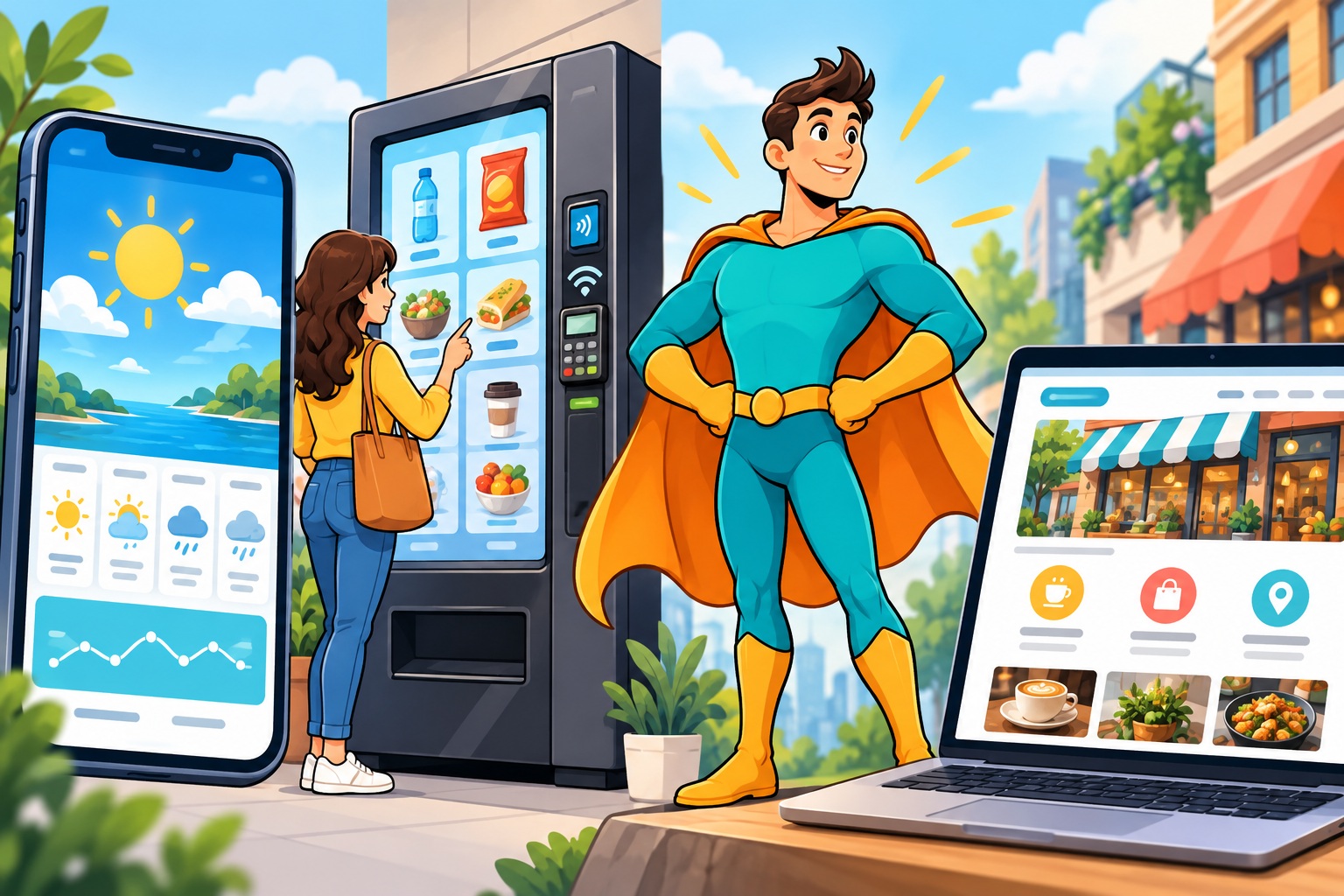
Think of Clark Kent and Superman. Your public website introduces the business: who you are, what you offer, and how to contact you. Its app side does the work behind the scenes. You do not need superhero-sized software to benefit. A dependable contact form or booking tool can be enough.
A weather app provides another familiar example. The screen looks simple, but the forecast depends on information supplied behind the scenes. A touchscreen vending machine works the same way: you make a selection, and other systems handle availability and payment. A business website can combine an attractive screen with useful services, too.
Choose Hosting for the Work Your Site Does
Hosting is the environment that makes your website available online. The right choice depends on what the site must do, not whether AI helped build it.
A simple brochure site can use ordinary static hosting. Some modern React or Vite projects build into files that a static host can serve. Next.js also supports static exports, although features that require a server need a different deployment arrangement. Tailwind styles your pages; it does not by itself require special hosting. [1] [2]
If you need saved inquiries, secure editing, customer accounts, or live AI features, ask how those functions run. They may use your host’s server, a separate backend service, or a serverless platform. Serverless means the platform manages the servers; your application still uses them.
Traditional hosting can be suitable when its supported software and services match your project. WordPress remains a practical choice for many businesses. The question is whether the proposed plan supports your actual features, with reliable maintenance and clear costs.
Keep Private Connections Behind the Counter
An API is a connection that lets software use another service, such as an email provider or an AI model. Some services require a secret key that identifies your account and authorizes usage.
Treat that key like the code to the stockroom. Your customers can use the sales counter without receiving the stockroom key. Similarly, a website’s server can send an inquiry notification without exposing the email-service credential in the customer’s browser.
Keep private keys in protected server settings. Cloudflare Workers supports secrets for sensitive values. The visible page should send only the information needed for an authorized action. [3] Ask your developer where secrets live, how access is checked, and how unexpected usage is limited.
Updates Should Be Easy to Review and Recover
AI can help produce changes quickly, but a fast draft still needs review. A practical release process keeps a history of the website’s source, checks a proposed change, and publishes an approved version.
GitHub can hold that source history. Compatible deployment tools can build and publish from it. This approach makes repeated improvements easier to track, but it is not exclusive to one kind of host. Ask for a way to preview changes and return to a working version if something goes wrong.
Cloudflare Can Support the App Side
Cloudflare Workers can run application code, and Cloudflare offers tools for serving website files and connecting data services. That makes it one option for websites that combine public pages with behind-the-scenes functions. [4]
Cloudflare also offers security services, but a platform name or a dashboard switch does not make every application secure. Protection depends on the services enabled, plan limits, configuration, and the application’s own controls. Secure admin access, validated forms, backups, and maintenance still matter.
Ask what happens when traffic or service usage rises. Hosting, email delivery, AI calls, and storage may have separate limits or charges. Agree on who monitors them and who receives alerts. No host can promise that a website will never fail or face an attack.
Protect the App from Bad Bots and DDoS Attacks
Your website’s app features need ongoing protection from bad bots and DDoS attacks. Bad bots can submit junk inquiries, attempt repeated logins, or abuse paid services. A distributed denial-of-service attack, or DDoS attack, floods a service with traffic so genuine customers may struggle to reach it.
Use suitable bot controls, request limits, protected admin access, and DDoS defenses alongside monitoring and maintenance. Cloudflare provides bot and DDoS protection tools, with features that vary by service and plan. Configure protection for the site’s actual features and check that legitimate customers can still use them. [5] [6]
Visible Strategies AI Plans for Your Business Growth
Visible Strategies AI takes these hosting, app security, and maintenance needs into account when planning its website packages. The goal is to help you attract more customers and grow your business through clear information, useful features, and a dependable customer experience. We define the features, protection, and support included in your package so you understand what your site needs as your business grows.
Buy Useful Features You Can Understand
Start with your next business task. Do you need more quote requests, easier appointments, or a place to review leads? Define that result before buying extra technology.
Before committing, ask your provider to show the feature working. Submit an inquiry, reopen its saved record, and confirm the alert arrives in the intended inbox. For an admin tool, check that your edits stay saved and unauthorized visitors cannot make changes.
Keep your domain, hosting account, website files, and recovery arrangements under the agreed ownership terms. Then choose maintenance that covers the work your site actually needs. Your website’s most valuable superpower is helping customers and saving you time.
Questions and Answers About Website Apps and Hosting
Q. Does an AI-built website always need special hosting?
A. No. AI is a way to create the site, not a hosting requirement. A simple site may use static hosting. Features that need private processing, stored records, or secure accounts need compatible backend services.
Q. Can I keep my current hosting company?
A. Possibly. Ask your developer to check the exact plan against the site’s requirements. Sometimes the current host can run the whole project; sometimes a separate backend or a different plan is needed. Avoid switching solely because the site was built with AI.
Q. Why can’t the website put a private API key in the customer’s browser?
A. Visitors can inspect code delivered to their browsers. A private key exposed there may let someone use your account or incur charges. Keep it on the server and allow only the actions your application authorizes.
Q. What should a maintenance option include for a website app?
A. Agree on form and notification tests, software updates where applicable, backups and recovery checks, access review, failure monitoring, and usage-limit checks. Define the response time and what is billed separately. Maintenance reduces problems but does not guarantee uninterrupted service.